A journey that began in 1999 with a small Bengali community celebrating Durga Puja with a painting of Goddess Durga painted by a Finnish lady has, more than 25 years later, reached an important milestone in Finland’s national cultural heritage landscape.
In 2024, an article on “Indian Durga Puja in Finland” was prepared for Finland’s Wiki Inventory List for Living Heritage in collaboration with the Helinä Rautavaara Museum and KAMU Espoo City Museum, whose collections preserve earlier Durga idols, photographs and audiovisual materials documenting the celebration. The List maintained by the Finnish Heritage Agency is essentially Finland’s open, community-based platform for documenting all intangible, or living cultural heritage practiced in Finland.
This created the foundation for the next step: applying in early 2026 for inclusion in Finland’s National Inventory of Living Heritage, which is updated every 3 years.
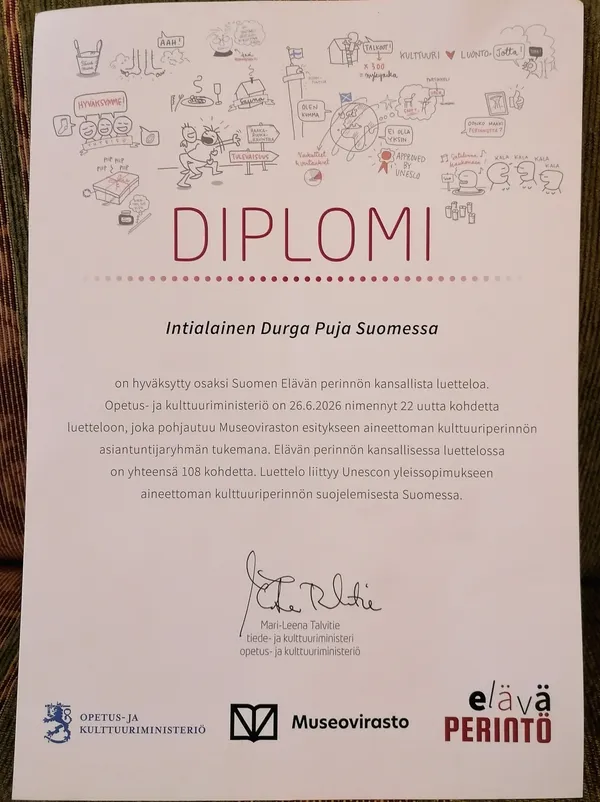
Following the application and subsequent questions and clarifications, the long-awaited news arrived. On 26 June 2026, the Ministry of Education and Culture officially added Indian Durga Puja in Finland to the National Inventory of Living Heritage, together with 21 other new elements.
A diploma and a moment of recognition
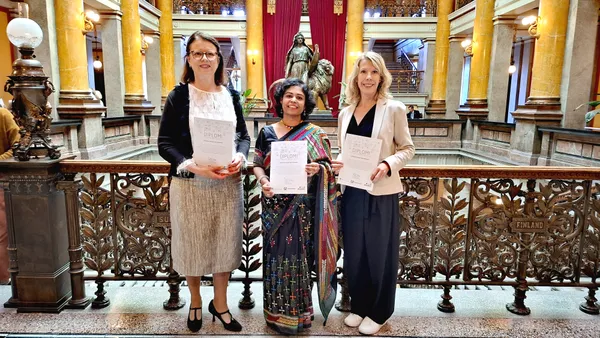
The journey reached a very special moment on 10 September 2026, when a representative of BAF attended a ceremony hosted by Finland’s Ministry of Education and Culture and organized by the Finnish Heritage Agency to receive the diploma marking the inclusion of our festival in the National Inventory. Representatives of our museum partners were also invited to join us in marking this important achievement. Minister of Science and Culture Mari-Leena Talvitie presented the diplomas. During the ceremony, the BAF representative also had the opportunity to speak about how Durga Puja is practised in Finland and importantly, how its traditions, knowledge and cultural practices are being transmitted to younger generations.
For our community, receiving this diploma was much more than receiving a mere certificate. It represented recognition, visibility and belonging.
But what exactly does this recognition mean?
Finland’s National Inventory identifies forms of intangible cultural heritage that are practised in Finland. According to the Ministry of Education and Culture, inclusion requires an element to be living heritage, to increase understanding of cultural heritage, and to be based on the active participation of communities.
Therefore, the recognition of Durga Puja is significant in several ways. It acknowledges that the present cultural heritage of Finland is diverse and continuously evolving. People bring knowledge, memories and celebrations with them, practise them in new surroundings and pass them on to their children. Durga Puja continues to represent our Bengali heritage and identity, but it now carries another meaning too: it is part of Finland’s nationally recognised living heritage and in that sense, represents the diverse and evolving cultural identity of Finland itself.
In the large picture, it gives visibility to the contribution of immigrant communities to Finland’s cultural landscape. The Finnish Heritage Agency notes that the 2026 round strengthened the representation of minority traditions, with both Japanese Hanami and Indian Durga Puja among the traditions included.
From a painting of Ma Durga in 1999 to recognition in Finland’s National Inventory in 2026, it has been a remarkable journey, made possible by every Bengali who has contributed to the celebration and helped keep the tradition alive over the years. This recognition belongs to the entire community, to those who started the journey, those who continue it today and the younger generations who will carry it forward. It is a proud acknowledgement that the traditions we bring with us have become part of the shared cultural heritage of the place we now call “home”.